Introduction
The Center for International Studies (CIS) in UP Diliman is an academic unit established on 10 October 2000 in order to foster multi-interdisciplinary studies of countries around the world.
Twenty-six years on, it has been continually growing as a hub for learning, teaching, research and extension work on local-global issues.
Its organizational structure provides a Director that heads the Center, assisted by three Coordinators for the different areas (i.e. Americas, East and Southeast Asia, and Europe).
In addition to its four resident faculty, the CIS has around twenty faculty affiliates and a number of lecturers.
For undergraduate students, it offers three GE courses: Social Science 1 and 2, and SEA 30. Other area-specific offerings of the CIS are its two Japan Studies electives. Its Global Studies elective is a Special Topics course. SEA30 was offered to respond to the need for new GE subjects during the implementation of the Revitalized General Education Program (2002).
The CIS was also able to propose Japan Studies and Global Studies programs. The Japan Studies program was proposed in the early 2000s. This was endorsed by the President’s Advisory Council (PAC) to the University Council (UC). At the level of the UC, only Japan Studies 100 and 101 were approved to be instituted as courses. The
UPCIS Global Studies program was proposed to the PAC as Bachelor of Global Studies (BAGS) in 2007. The Coordinating Council was subsequently convened, and it recommended that the Global Studies Special Topics be instituted as a course (GS 197) in the same year.
As the Center approaches its third decade, it continuously evolves with the changing academic landscape in the University of the Philippines. This Five-year Development Plan is an effort at directing the future of CIS. It has been revised (2022) in view of the impact of the pandemic and the appointment of a new director for the CIS.
Ia. Faculty Development Plan
The CIS has four resident faculty, all tenured and with postgraduate degrees:
- Professor Ramon Guillermo — PhD Austronesian Studies, University of Hamburg, Germany
- Professor Amparo Adelina C. Umali III – PhD Japanese Literature, Doshisha University, Japan (Professor Umali will be applying for sabbatical before retirement.) 3. Assistant Professor Sarah Jane S. Raymundo – MA Sociology, University of the Philippines – Diliman
- Assistant Professor Raymond Aquino Macapagal – Master in Food Culture and Communication, University of Gastronomic Sciences, Italy; Master in World Heritage and Cultural Projects for Development, University of Turin, Italy
All of them coordinate and teach in the various Global Studies Special Topics courses, SEA 30, Soc Sci I and Soc Sci II GE, and Japan Studies courses.
The Center is assigned five faculty items as per our BOR mandate. We look forward to claiming the fifth item in order to broaden the base of expertise which the CIS is able to offer. In particular, since two of our faculty members (Guillermo and Umali) are mainly trained in the humanities while the other two (Raymundo and Macapagal) have stronger social science backgrounds, we need to strengthen our available expertise in areas such as global political economy.
The way we complement our faculty roster is by recruiting faculty affiliates from within the UP System, hiring lecturers and resource persons from outside who are external experts, and taking in Visiting Professors, Artists, and Research Fellows. These faculty affiliates, lecturers, Visiting Professors, Artists, and Research Fellows join the resident faculty in team-teaching the courses.
In light of the UPCIS proposal to turn itself into a degree-granting unit, the UPCIS faculty agreed to have Assistant Professors Raymond Macapagal and Sarah Raymundo commence their applications to a doctoral program within the year 2020. However, their respective applications were postponed on account of the very precarious conditions resulting from the pandemic. Macapagal and Raymundo nevertheless took advantage of the call for applications to the newly opened Doctoral Program in Indigenous Studies offered by the College of Social Sciences, University of the Philippines-Baguio. By August 2021, both were informed about their successful application and have been in the program since then.
Professor Macapagal’s PhD proposal work is ongoing and his projected dissertation defense by 2027. He was on study leave for 3 years (AY2021-22-AY2023-24). Professor
Raymundo is still on study leave and is undertaking fieldwork for her dissertation in Venezuela. Her projected dissertation defense is also in 2027.
Thematic Areas of Teaching, Research and Extension
The CIS plans to further develop its research, teaching, and extension agenda in cultural and intercultural studies with the following sub-themes:
- Tangible and Intangible Cultural Heritage (Macapagal and Umali) ● Indigenous/Local Knowledge and Biodiversity, Cultures of Disaster, and Climate Justice (Guillermo, Macapagal, Raymundo, and Umali)
- Gender and Sexuality (Macapagal and Umali) • Migration, Displacement, and Dispossession (Raymundo and Umali) • Maritime Cultures (Raymundo) ● Global Translation Studies (Guillermo) • Digital Humanities and Digital Cultures (Guillermo)
- Third World and Global South Social Movements (Guillermo and Raymundo)
In light of the approval of the general framework for minor programs, the CIS envisions co-offering minor programs in Japan and Korea Studies.
China Studies and Southeast Asia Studies are also to be proposed as minor programs in the future. There is also a proposal to work on a Global Gender Studies minor program in coordination with the UP Center for Women’s and Gender Studies.
Presently, the UPCIS is developing and offering courses in the areas of Europe and the Americas in cooperation with faculty affiliates from various UP departments, and Lecturers. This is in consonance with its BOR approved mandate to jointly offer degree programs with other units.
Ib. Staff Development Plan
Most of the staff are currently doing their MA Studies. The UPCIS supports their plans for graduate studies.
The faculty and staff should receive a regular orientation on their rights, welfare, and benefits (for ex., Wellness Break) from the academic union and the Alliance of Contractual Employees (ACE-UP).
The UPCIS must obtain an Admin Officer (AO) item as soon as possible.
The staff shuld be encouraged to participate in various academic and cultural exchange programs as graduate students and be assisted in their prospective applications as graduate students in CIS’ partner universities and networks
I. Coordinatorships and the Minimalist-Accordion Approach to Area Studies
In the proposal to establish the UPCIS, the three areas – Asia, Americas, and Europe – were initially specified.
The BOR then appointed area Coordinators to assist the Director. These areas have since evolved into: East and Southeast Asia, the Americas, and Europe. The Coordinators perform various activities related to teaching, research, and creative work, and extension and internationalization. Since coordinatorships must be based on existing specializations and competencies, our current faculty can be distributed as follows:
- East Asia (Umali), Southeast Asia (Guillermo, Macapagal, and Umali) ● The Americas (Raymundo) •
- Europe (Guillermo and Macapagal)
We adopt a minimalist approach to course offerings and an accordion-like expansion of international intellectual collaboration. By minimalist accordion approach we refer to the organizational structure of the CIS of only having four resident faculty (minimalist) who,
in their capacity as Coordinators, are tasked to expand the roster of teachers by recruiting faculty affiliates and outside lecturers who can team-teach the courses (accordion).
The Coordinators, apart from taking charge of all the activities per area, also perform the following course-management tasks: (a) prepare and distributes syllabus, (b) conduct course orientation, (c) synthesize the team-taught course and administer examinations by the end of the semester, (d) collect grades from lecturers, (e) compute final grades, (f) officially submit final grades, (g) oversee removals and completions, (h) respond to student queries related to grading (i) hold meetings with team teachers pre and/ or post- semester.
We currently have four multi/interdisciplinary course categories: one GE area studies (SEA 30), two country studies (JS 100 and JS 101), and one Special Topics (GS 197) courses (expanding to about twenty Global Studies courses), which are team- taught
representing various disciplines and areas – East and Southeast Asia, the Americas, and Europe. The Center also offers Social Science I and Social Science II as service courses. The Global Studies courses take into consideration contemporary country,
area, and global topics. Below is the list of courses the Center has created so far under GS 197 encompassing the three areas and larger global concerns:
EAST AND SOUTHEAST ASIA
- Asian Performance Practice
- Japanese Traditional Performance Practice
- A Bite of China: An Introduction to Chinese Culture and Society ● Introduction to Contemporary Korean Society
- The Making of Global Korea
- Korean Traditional Performance Practice
- Japan Studies 100
- Japan Studies 101
(JS Studies to be renumbered (100 > 101; 101 > 102) and minor revisions on the content; for UC level approval)
- SEA 30 (General Education Course)
WEST ASIA
- Palestinian Justice, Settler-colonialism and State Violence Across the Globe
EUROPE
- Integration and Separatism in Europe
- Where Continents Connect: Mediterranean Cultures and Societies ● Kebab, Charlie, Burkini, and Hijab: Islam in Contemporary Europe ● The Eurasian Melting Pot: An Introduction to Turkish Culture and Society
AMERICAS
- The Greater Americas: Cultures of Resistance in Latin America and the Caribbean
GENERAL GLOBAL STUDIES TOPICS
- Diversity in Culture, Gender and Sexuality
- Current Lesbian, Gay, Bisexual, Transgender, Queer, and Intersexed Issues around the World
- Diversity of Perspectives on Peace and Conflict
- Cultures of Disaster: Learning from Life Experiences
- Eco-Cultural Adaptations in Volcanic Environments: Lessons from Italy, Iceland, Japan, Indonesia, Philippines, and the USA
- Biodiversity and Climate Justice: No Planet B
- Cultures and their Global Entanglements
- Modern Heroes, Modern Slaves: Departures and Arrivals in the Global Diaspora ● Global Gastronomy: Exploring the Universe of Food
The Coordinators also function as initiators and implementers of research, creative, and extension work in the CIS. Research and Creative Work pertain to researches, journal
articles, books published and creative works produced both in local and international platforms.
The Coordinators also undertake extension and internationalization work in the three areas which include the organization of the following: symposia, fora, conferences, lectures, workshops, study tours, intercultural exchanges, initiating, processing and implementing of Memoranda of Understanding (MOU)/Agreement (MOA), and scholarships/awards/grants. Through the Coordinators, the CIS is able to host and entertain Visiting Professors, Artists, and Research Fellows.
Professor Macapagal has resumed teaching and coordinatorship duties but may apply for a study leave when he begins to write his dissertation. Professor Raymundo still on study leave which means the that America Area Studies is on hold. In the meantime, the Coordinator for East and Southeast Asian Studies will continue to pursue the institution of a minor degree in Japan Studies.
III. Establish an Interdisciplinary MA in Global Digital Humanities
Though initially promising, difficulties were encountered in pursuing the originally proposed MA Global South Studies.
The implicitly “developmental” orientation of the degree risked the problem of “turfing” in relation to other departments and colleges in the university which are more traditionally focused on development work and policy studies in the governmental and non-governmental sectors. The proposed curricular framework did attempt to maximize the strengths of the CIS by emphasizing linguistic, cultural, intellectual, and critical dimensions, but it then faced crucial questions regarding the students who would enrol in such a graduate degree.The reality is that even such programs as the one at the University of Tübingen is oriented towards training “culturally sensitive” First World aid and development workers. The CIS, at present, has little to offer in terms of “training” professionals and workers in the non-governmental sector in more effectively pursuing their objectives.
This second issue is compounded by the “crisis of interdisciplinarity” in contemporary academe. Opportunities for academic employment have generally prioritized more conventional disciplinary paths than interdisciplinary ones.
Context and Rationale for an MA Global Digital Humanities
“Digital Humanities” (DH) refers, most simply, to the “computational turn” in the humanities which involves the increasing usage of computational methods, techniques, tools, and perspectives in the humanities.
The current CIS director is a recognized DH proponent and practitioner in the Philippines. In this capacity, he has engaged in various national and international academic research projects and activities. He has also led and conducted DH workshops and lectures in many Philippine academic institutions.
The initial idea for a possible MA GDH was developed in conversations by RGG with Cristina Juan, the project head for Philippine Studies at SOAS University of London. After a Philippine Studies workshop devoted to the topic of “Digital Repatriation” in 2023, the idea came up regarding possible collaboration between SOAS and the CIS in DH oriented course offerings to be conducted primarily online. Conversations with Juan on this project are continuing. RGG was also on the panel defense of Frances Cruz (UPD DEL and CIS Affiliate) at the Uni Antwerp for her dissertation “Digital Specters of Colony: Securitization, Moros, and the Age of Social Media” (2025) which demonstrated mastery over the contemporary cutting edge approaches in DH research. Her graduation meant that the UP is now developing a stronger base for offering DH as a distinct academic offering.
More recently, both RGG and RAM participated in a week-long DH-oriented training/ seminar at the Bavarian Academy of Sciences (2026) which promises further institutional collaboration and individual academic enrichment.
On March 12, RGG, RAM, and Frankie met with UP VP for Digital Transformation Peter Sy to get his support and advice. On June 11, RGG and Frankie met with DEL Chairperson Anna Sibayan to consider the suggestion that DEL be a co-proponent of the MA DGH course. Both Peter and Anna were supportive of the CIS proposal.
We are not aware of any UP academic unit at present offering or developing a degree in DH. What makes the MA GDH particularly suitable for the CIS (and for DEL) is its “global” component. The University of St Andrews, UK, currently offers the course “Global Digital Humanities.” Other universities offering “MA Digital Humanities” like Linnaeus University, Sweden, University of London, and University of Cambridge offer similar course content and frameworks.
Training of CIS faculty in DH and revision of current modules for use in team-taught GDH courses will be planned. The projected proposal of the program is within PAJ’s term (2028).
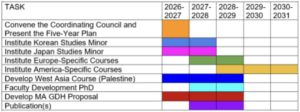
IV. Schedule (2026) of targets of the CIS five-year Development Plan (2026-2031)
V. Benton Hall and Plans for UPCIS
The CIS must work with the office of the UP Diliman Chancellor towards finding a longer term solution the deteriorating state and the uncertain position of the CIS in Benton Hall.
IV. The UP CIS Official Website
The CIS Website (https://cis.upd.edu.ph/) is now online and undergoing further improvements. Staff will be trained to manage and update the website regularly.